Showing posts with label Night. Show all posts

Wednesday, April 1, 2020

Comet ATLAS - view from Sri Lanka


Comet ATLAS has faded away. It never reached the expected brightness and scientists believe that the comet disintegrated to smaller pieces making it fade. 

However, we got a new comet - SWAN. it has brighten to magnitude 5 already. So, lets keep fingers crossed. I will have a separate page on it. 


We are SO OVERDUE for a decent - read visible to the unaided eye - comet in the Northern Hemisphere. Maybe, just MAYBE, our wait is over. Comet ATLAS has been brightening quite nicely and is currently visible in binoculars.

The comet is in the northern sky right now near the Big Dipper. See the star chart below.

Comet Atlas is racing toward the inner solar system, and it could become the brightest comet seen in the night sky in over two decades. The comet, discovered by an observatory designed to protect Earth from asteroids, may even be visible during the day just two months from now.

Also known as C/2019 Y4, this comet was discovered by astronomers at the Asteroid Terrestrial-impact Last Alert System (ATLAS) in Hawaii in December 2019. At the time, the comet was exceedingly dim — but the comet became 4,000 times brighter in just a month. This increase is far greater than astronomers predicted, and could potentially signal the comet may soon be exceptionally bright.


Comet ATLAS proved a close match to the Great Comet of 1844 (C/1844 Y1). Both have periods around 4,000 years, approach within 0.25 astronomical unit (a.u.), or 37.4 million kilometers, of the Sun at perihelion, and are inclined 45° to the ecliptic. These and other orbital similarities were strong enough to conclude that both objects were fragments of a single, much larger comet that broke apart about 5,000 years ago. For all we know there may be additional fragments en route for future appearances.

It is expected that the comet will continue to brighten, and it is possible the comet may be visible to the naked eye sometime in April or May 2020. It will reach its nearest point to Earth on May 23 and come to perihelion (closest to the Sun) on May 31.

Watch this space and register to SkyAbove news alert (SMS - "REG SKY" to 77000 on your phone) for further details on position of the comet.

So, it is understood that comet Atlas has disintegrated and below pictures prove it. 


Tuesday, January 31, 2017

The Andromeda Galaxy


The Andromeda Galaxy is the closest Galaxy to the Milky Way Galaxy that we are in. Hence, logically, it should be visible isn't it? But, how many has observed / seen it ? 

The reason is that the Galaxy is so far away, you would see it as a faint single star. The below illustration indicates the distance between the two galaxies. If we see the largest and the brightest star in Milky-way as a dot, Andromeda being at the distance it is, appear faint too.  


However, it is observable to the naked eye if you are outside the city limits. Colombo, is quite bad as an observing site. However, a decent pair of Binoculars should do the trick.

So, How do we find it ?


In the night sky above Sri Lanka, Andromeda is to the northern hemisphere. Watch for the Constellation Orion - Draw a mental straight line towards north west direction and you should arrive at the area that is circled in red in the above diagram. You would see the below star charts in this area and locate the Galaxy as shown. Mind you, it is not the colourful Galaxy you would see as in the first picture of this blog - those are long exposure (at least 30 minutes) shots that makes it colourful. 


If you observe the sky from a clear, unpolluted location, you would most probably see a sight as below - it would be easier for anyone to spot the galaxy through naked eye if the skies are really clear. What you see like a puff of dust is Andromeda. 


If you use Bino's or telescope you would see something like below.


Happy Andromeda Hunting. Please provide feedback if you spot the Galaxy and feel free to share pictures. You can comment below. 

Friday, January 20, 2017

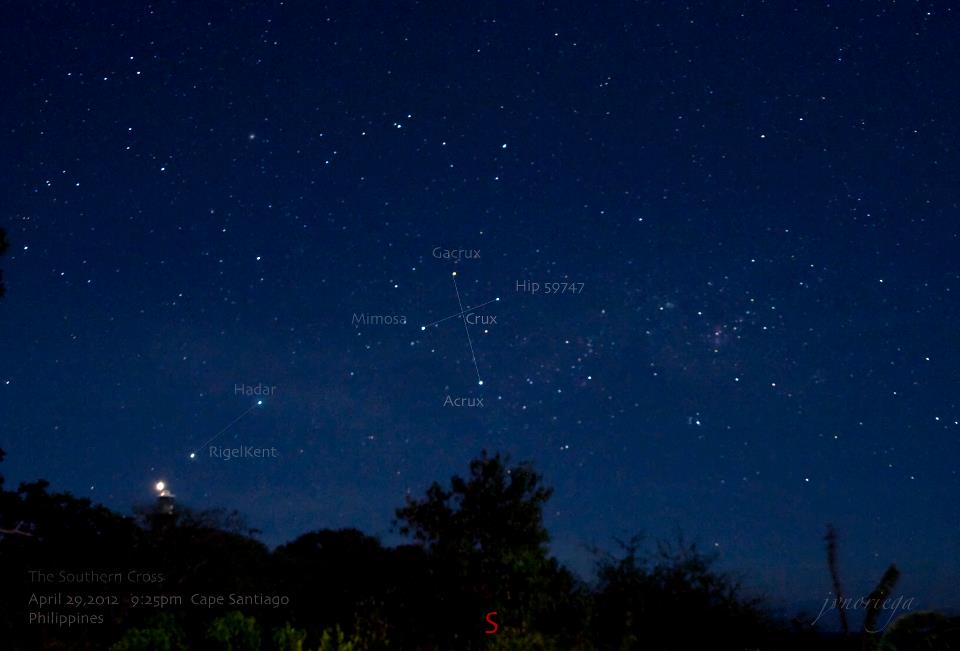
The Southern Cross (Crux Constellation)

Click on images for larger versions. Please share with fellow Lankans who wish to learn and enjoy the beauties of the night sky.


The Southern Cross or the Constellation Crux is visible most months throughout the year and is visible in the southern sky.

The importance of this constellation or star pattern is that when you connect the stars in the form of a cross, it always points to the absolute south or the south pole of the earth.


In January, it is visible in the morning skies and will shift to the evening skies by June. However, based on earth's position vs. the Sun, the constellation is one of the most visible and beautiful sights in the skies..


Enjoy ...


Saturday, January 14, 2017

NGC 2451 Open Cluster - January


An open cluster is a group of up to a few thousand stars that were formed from the same giant molecular cloud and have roughly the same age.


The NGC 2451 Open Cluster probably discovered by Giovanni Battista Hodierna before 1654 andJohn Herschel in 1835. In 1994, it was postulated that this was actually two open clusters that lie along the same line of sight. To the Naked Eye, a cluster usually is seen as one star due to the distance from earth. However, mindful observation allows you to see many stars combined together as in a powder puff. 


The open star cluster NGC 2451 in Puppis (click) will be well placed for observation during January and beyond. It will reach its highest point in the sky at around midnight Sri Lanka time.  Refer below Map and the red circled area. Click on image to enlarge.   
At a declination of -37°58', it is easiest to see from the southern hemisphere but cannot be seen from latitudes much north of 32°N.
From Sri Lanka, it will be visible between 19:54 and 04:30. It will become accessible at around 19:54, when it rises 15° above the south-eastern horizon, and then reach its highest point in the sky at 00:14, 45° above the southern horizon. It will become inaccessible at around 04:30 when it sinks to 15° above your south-western horizon.
At magnitude 2.8, NGC2451 is visible to the naked eye, but best viewed through a pair of binoculars.